
🌿 THE GOOD AI
The company building the next AlphaFold just raised $2.1 billion
On May 12, Isomorphic Labs, Google DeepMind's drug-discovery spinoff, closed the largest AI-biotech funding round of 2026. The $2.1 billion Series B was led by Thrive Capital and backed by Alphabet, Temasek, MGX, CapitalG, and the UK Sovereign AI Fund.
The capital will scale IsoDDE, an AI drug design engine that scientists are already calling AlphaFold's successor. On the Runs N' Poses benchmark, IsoDDE more than doubles AlphaFold 3's accuracy on its hardest protein-ligand interaction cases, the computationally intensive calculations that tell researchers exactly how a designed molecule will bind to its biological target. Active partnerships with Novartis, Lilly, and Johnson and Johnson are underway, and Isomorphic Labs is targeting clinical trials before the end of 2026.
What AlphaFold changed was the ability to predict how a protein folds, a problem that had stumped biology for 50 years and previously required months of lab work. AlphaFold solved it in minutes and unlocked a generation of new drug discovery programs. IsoDDE goes further: it models how a designed molecule interacts with that protein, letting researchers optimise for both binding strength and safety simultaneously.
The implications extend well beyond blockbuster drugs. For rare diseases, neglected diseases, and antimicrobial resistance, areas where traditional pharma economics have historically failed patients, compressing the molecule-to-trial timeline by years could matter enormously.
The honest caveats: benchmark gains don't guarantee clinical success. Many promising molecules fail in trials for reasons computational models cannot fully predict. And the funding scale raises real questions about pricing and equitable access to whatever medicines emerge.
Sources: PR Newswire, Fierce Biotech
⚡ 3 GOOD SIGNALS
⚡ Colorado rewrites its AI law, and 91 legislators voted yes
Colorado Governor Polis signed SB 189 on May 14, replacing the state's ambitious but unworkable 2024 AI Act with a practical transparency law. The core principle survives, telling people when AI is used to deny them loans, jobs, or major decisions, but the risk assessment mandates that had stalled implementation are gone. It passed 34-1 in the Senate and 57-6 in the House. In a fractured national policy environment, that bipartisan signal matters.
Source: wsgr
🤝 Google launches free monthly AI training for all 6 million US teachers
Google debuted its AI Educator Series on May 13, with new training modules released monthly, targeting every K-12 and higher-education teacher in the United States. The initiative also brings Gemini directly into Moodle via LTI, letting teachers assign AI tools within their existing learning management systems. McKinsey's 2026 data show that 78% of K-12 schools now use AI tools, but teacher training has lagged significantly. This is a direct attempt to close that gap.
Source: Google Blog
🌱 AI cameras are detecting wildfires 45 minutes faster than 911 calls
An AP investigation published May 5 documents how Pano AI cameras are now operational across 17 states, detecting 725 fires in the US last year alone. In Arizona, the technology caught the Diamond Fire early enough to contain it at just 7 acres. During a Nebraska wildfire, AI-assisted rapid response likely saved over $850 million in structures. Detection now routinely outpaces 911 calls, which changes what first responders can do.
🔬 THE DEEPER DIVE
Is the AI energy panic missing the bigger picture?
The loudest criticism of AI right now isn't about jobs or safety, it's about power. Data centers running large language models consume staggering amounts of electricity. Goldman Sachs has estimated that data center power demand could rise 160% by 2030. The dominant narrative is clear: AI's environmental cost is a serious problem that needs solving before it spirals.
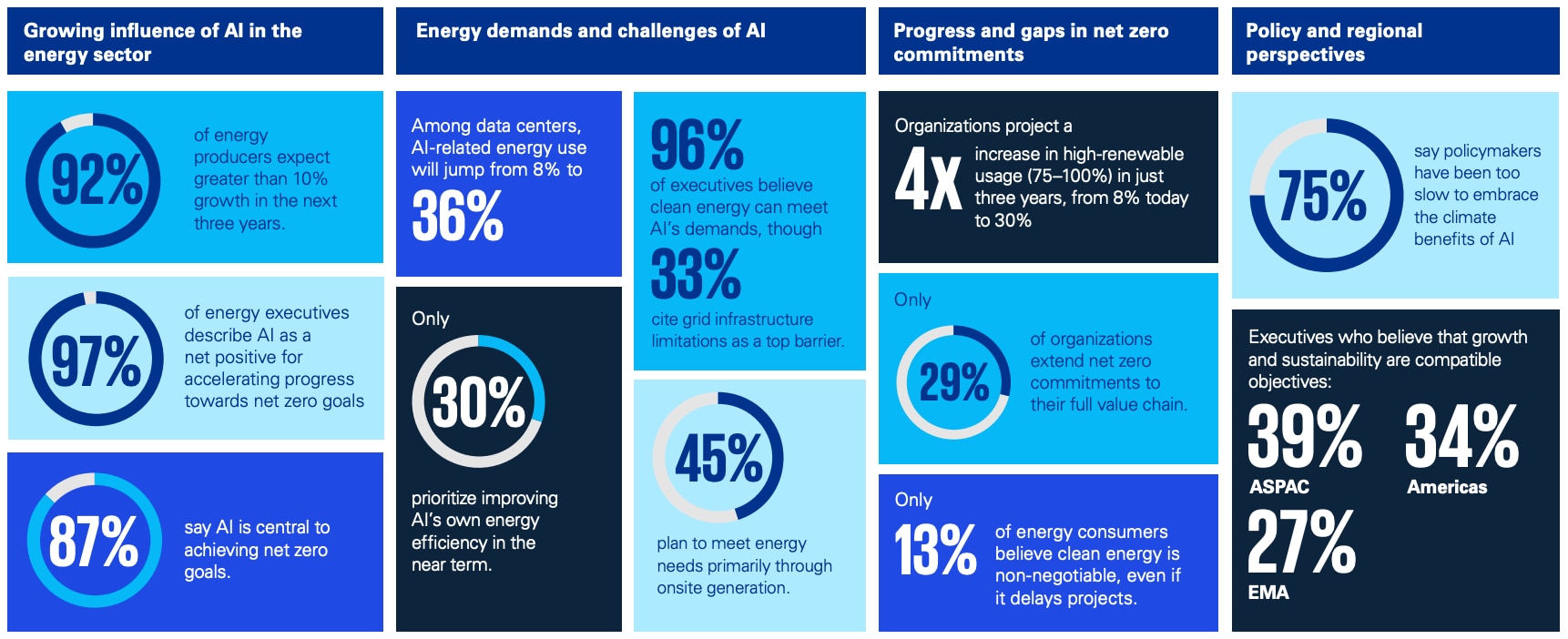
A KPMG report published via the World Economic Forum on May 13 challenges this narrative directly. Surveying more than 1,200 energy leaders across 20 markets, it finds that AI's "climate handprint," the positive impact of helping other industries cut emissions, already outweighs its energy footprint. AI is helping grid operators predict demand, balance renewable supply in real time, optimise industrial efficiency, and accelerate clean energy deployment. The report notes that for the first time in three decades, the economics and ethics of energy transition are beginning to align. Sixty-two percent of respondents expect major AI operators to self-generate clean energy by 2027.
The case for net-impact accounting
The report essentially makes an argument for a different unit of measurement. Instead of asking "how much energy does AI consume," it asks "what would have happened without AI." If an AI-powered grid management system prevents a gas peaker plant from switching on, the avoided emissions count. If an AI logistics tool cuts fuel consumption across a fleet, that counts too. The KPMG data argues these downstream effects, aggregated across millions of deployments, already outweigh the footprint of running the models themselves.
Our PM + Risk Manager lens
For product managers building AI-powered tools, this reframes a question that will keep coming up: What is the carbon cost of our product? The more accurate frame is net impact, not gross footprint. If your tool reduces energy consumption in a supply chain, prevents food waste, or eliminates unnecessary diagnostic tests, its computational cost needs to be weighed against the avoided emissions. That is not a way of dodging the question; it is a more honest way of answering it. Building that case requires measuring downstream impact, which most teams are not yet doing. The ones that start now will be in a much stronger position when regulators and procurement teams start asking.
The risk in this finding is the same risk that comes with any measurement that cuts against the prevailing narrative: it can be misused. A company that cites "AI's net positive climate impact" as a reason not to invest in energy efficiency is greenwashing, not reasoning. The KPMG survey also reflects what energy leaders believe, not what has been independently audited at scale. The 62% self-generation forecast is a stated expectation, not a legal commitment. And if AI's energy demand grows faster than its climate handprint expands, the math changes. The optimism is warranted, but the self-assessment needs external verification.
The next 12 to 24 months
The clearest near-term test will be hyperscaler energy commitments. Microsoft, Google, and Amazon have all made net-zero pledges and are building or contracting renewable capacity. If the 62% self-generation forecast materialises, the energy debate around AI shifts from "is this sustainable" to "is the transition happening fast enough." Watch for clean energy procurement announcements tied to data center expansions, and for the first independent audits that actually measure whether AI's climate handprint is as large as the sector currently claims.
🛠 TOOL OF THE WEEK
Claude for Small Business
On May 13, Anthropic launched Claude for Small Business with 15 agentic workflows and ready-to-run connectors for QuickBooks, PayPal, HubSpot, Canva, and DocuSign. The workflows cover payroll review, month-end close, cash-flow forecasting, invoice chasing, marketing campaigns, and contract review. For the roughly 33 million US small businesses where deep AI adoption sits at just 7%, this is the most practical on-ramp available today. Anthropic is pairing the launch with free in-person AI training workshops in 10 cities and a free on-demand AI Fluency course co-developed with PayPal.
→ Read more: Anthropic
💬 ONE QUESTION
AI's energy critics and AI's climate optimists are looking at the same technology and arriving at opposite conclusions. Which framing feels more accurate to you right now, and what evidence would change your mind?
Hit reply. We read every response.