
🌿 THE GOOD AI
The vaccine designed by AI just passed its first human test.
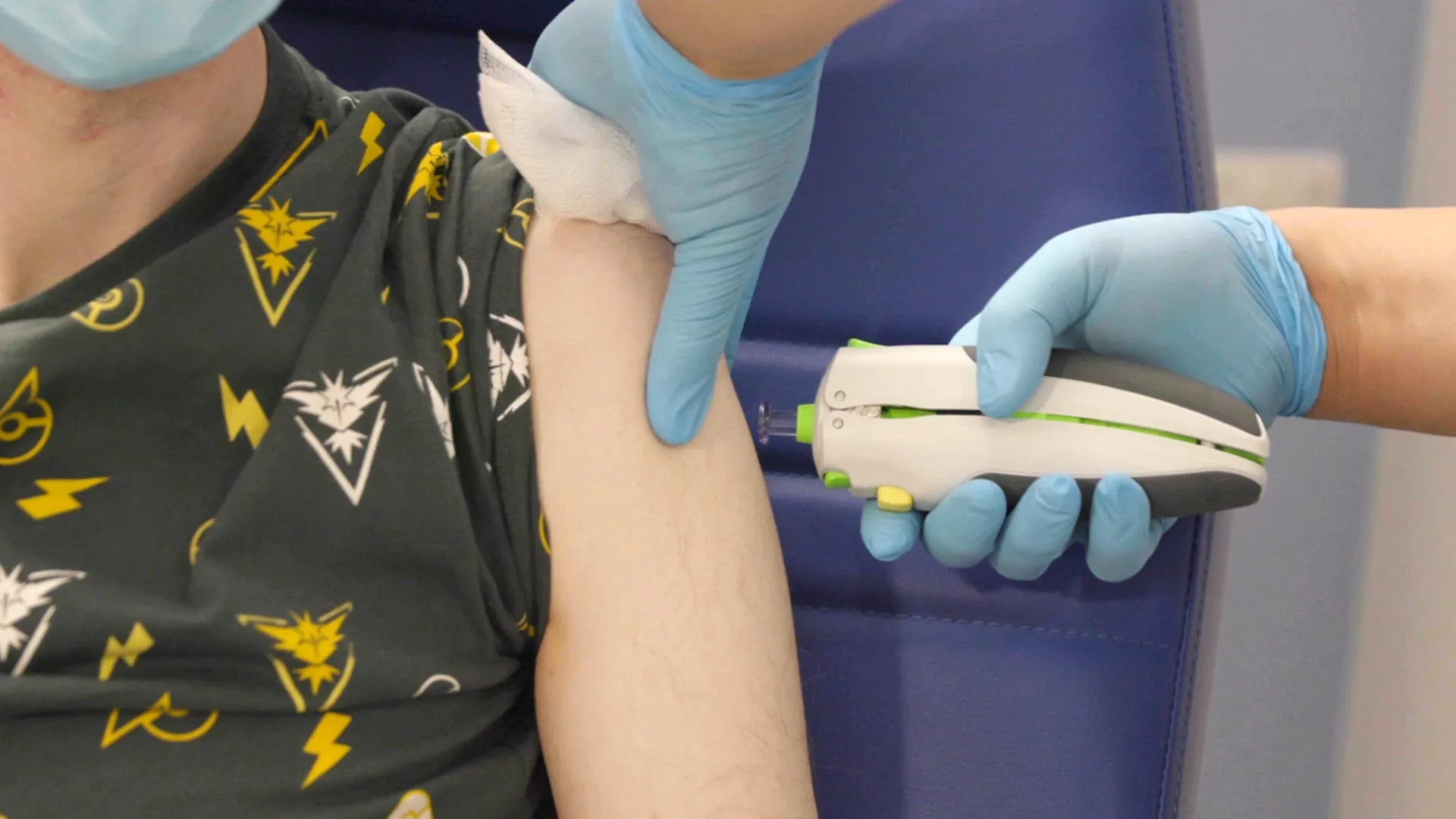
Most vaccines are built by scientists who study a known virus, identify a target on its surface, and design an ingredient that trains the immune system to recognise it. It works, but it has a fundamental limitation: every time a virus mutates significantly, the vaccine may need to be redesigned. We've lived through that limitation with COVID-19 for five years now. University of Cambridge researchers just showed a different approach is possible. Using AI and machine learning, they designed a "super-antigen" that doesn't target one strain of one coronavirus. It targets the features shared across the entire Sarbecovirus family, including SARS-CoV-2, the original SARS, and bat coronaviruses that have never infected humans but could. Their Phase 1 trial, published in a peer-reviewed journal and involving 39 healthy volunteers, showed a 100% safety profile with zero serious adverse reactions. The vaccine was delivered needle-free, which matters for large-scale rollout. The immune responses it generated were broad and cross-reactive, meaning the body learned to recognise not just one coronavirus variant but a shared structural feature across many. This is not a finished product. Phase 1 trials establish safety, not efficacy at scale. The harder work of Phase 2 and Phase 3 trials lies ahead. But what this result proves is the concept: AI can design antigens that humans could not have designed by hand, targeting conserved viral architecture that gives vaccines a fighting chance against future pandemics, not just the one we're currently in. The implications stretch beyond coronaviruses. If this approach works, it's a template for vaccines that are future-proofed by design.
⚡ 3 GOOD SIGNALS
⚡ AI's economic contribution may already be massive, but we can't measure it yet.
A new policy brief argues that the gap between what firms report (real, measurable AI-driven productivity gains) and what official GDP statistics show is a measurement problem, not a hype problem. The implication is significant: policy decisions about AI investment and workforce training are being shaped by statistics designed before AI existed.
Source: Fortune
🤝 Illinois just became the first US state to require independent audits of frontier AI.
Governor Pritzker has committed to signing SB 315, the Artificial Intelligence Safety Measures Act, which requires companies such as OpenAI and Anthropic to publish risk plans for their most powerful models and to submit those plans to third-party audits annually. The same legislative session also banned AI-enabled rental price fixing and AI bots mass-purchasing event tickets.
Source: NBC News
🌱 Code.org just became CodeAI, and the numbers behind the rebrand tell the whole story.
Eighty-four percent of US students already use AI, but only 16% of high school leaders say all their students are learning about it in a structured way. CodeAI, which has reached 150 million students across 190 countries, is repositioning its mission from teaching kids to code to ensuring every student has the AI fluency to navigate the world they're inheriting.
Source: PR Newswire
🔬 THE DEEPER DIVE
BCG just made its largest-ever social impact bet. Here's what makes it different from every corporate AI pledge you've seen.
Boston Consulting Group announced last week a $500 million commitment to AI for social impact by 2030, paired with a partnership with Anthropic to deliver hands-on support to up to 20 high-impact organisations in 2026 alone. Claude credits and training are included. The focus areas are education, workforce development, healthcare, and poverty reduction. That specificity matters. Most corporate AI pledges describe intentions. This one names the partner (Anthropic), names the year (2026), names the number of organisations (up to 20), and names the mechanism (direct consulting support, not just cash grants). BCG has already invested $1.5 billion and 3.5 million hours in social impact work since 2020, so this isn't a first move. It's a scaling move, and the addition of frontier AI changes what's achievable.
The gap this is designed to close
The organisations best positioned to help the most people, the ones working on food security, maternal health, refugee education, and financial inclusion, are often the least resourced to adopt and use AI. The corporate sector has been accelerating; civil society has been falling behind. BCG's framing of this as an "AI adoption gap" is accurate, and targeted support that combines AI capability with consulting expertise is more likely to produce real outcomes than cash alone.
Our PM + Risk Manager lens
For anyone building AI products, this is a useful signal about where institutional adoption is heading. The nonprofits and development organisations that receive this support will become early adopters and feedback sources for AI tools applied to genuinely hard problems: low-resource environments, multilingual users, high-stakes decisions. That's a different testing ground than tech-sector workflows, and the learnings will matter. Two questions worth watching. First, does this model scale in ways that preserve the agency of recipient organisations, or does it risk creating dependence on one firm's AI stack? Healthy AI adoption for civil society should build internal capacity, not just deliver outputs. Second, the Anthropic partnership is framed as consulting support, not just model access. The governance of how Claude is deployed in these contexts, what guardrails apply, who owns the outputs, will matter a great deal to the organisations being served.
The next 12 to 24 months
The 2026 cohort of organisations will be the test. If BCG and Anthropic can demonstrate measurable outcomes, this becomes a model that other consulting firms and AI companies will feel pressure to match. The more interesting development would be if civil society organisations use this access to build genuinely novel applications, ones that feed back into how AI systems are designed for low-resource contexts more broadly. Watch for that in the case studies.
Sources: BCG, PR Newswire
🛠 TOOL OF THE WEEK
Pano AI, Wildfire Detection Before the Fire Spreads
Pano AI is an early-warning platform that uses a network of cameras and AI vision models to detect wildfires, day and night, across more than 50 million acres. Its database of 4 billion images makes it one of the most comprehensive fire-detection systems in the world. In 2025, it flagged 735 vegetation fires and was the first known alert more than half the time. New this month: a "Time to Arrival" tool that estimates when a detected fire could reach critical infrastructure, giving utilities and emergency managers a window to act before escalation. Not a consumer tool. Most relevant to utility companies, emergency management agencies, and anyone tracking the intersection of AI and climate resilience.
→ Read more: Renewable Energy World
💬 ONE QUESTION
The Cambridge vaccine trial proves AI can design biological structures humans wouldn't have found on their own. If that approach extends beyond coronaviruses, to flu, RSV, or diseases we haven't named yet, what changes about how we think about pandemic preparedness?
Hit reply. We read every response.